
Discounting Discipline: Protect Your Revenue from Self-Sabotage
The rep wants to close. You approve the 20% discount. At renewal, your customer opens at the same number. Discounting is an easy decision to make, but you carry the consequences with you for a long time. The give/get framework and the approval matrix are tools for avoiding revenue self-sabotage.


The opportunity hits closed won. The customer wanted 20% off. It was the end of the fiscal year. The rep wanted to close. The team needed the win. You approved the discount.
Months later, the same customer opens the renewal conversation at -20%. Why wouldn't they? That is the price you already agreed to.
That is not a one-off discounting decision. That is a pricing precedent. The discount you approved in Q4 is the floor your customer negotiates from.
The discounting also hurts your NRR. Customers acquired at a heavy discount rarely expand to full price. The economics are different from day one. And when your customers learn that persistence earns approval at quarter end, they will plan around it. You are likely to see expansion happen with even reduced profits.
The fix is not "never discount." It is a discount intentionally, not defensively. Here is how to build that into a system.
CROs and VPs of Sales Read the GTM Club Newsletter
Subscribe to the GTM Club for actionable guidance on sales-led growth. Frameworks, metrics breakdowns, and templates that help you move from hope to systematic execution.
The Give/Get Discounting Principle
Every discount requires a trade. That is the whole framework.
What Sales gives is clear: price. What it gets in return must be documented, agreed, and tied to something the business actually values before the commercial terms are confirmed.
Common trades:
- Multi-year commitment in exchange for a lower annual rate
- Case study or reference rights in exchange for a first-year discount
- Accelerated payment terms (net 30 instead of net 90) in exchange for a modest percentage off
- Waving user training fees when committing to a minimum number of seats by the end of the first year.
- Expansion targets written into the contract as a condition of preferential pricing
The reason for the trade matters as much as the trade itself. A 15% discount tied to a two-year commitment and a reference customer is a business decision. A 15% discount because the rep felt pressure on the last day of the quarter is a pricing leak.
Every discount is a pricing decision. Make it on your terms, not theirs.
Not every give needs to be financial. Before moving on to price, consider what else you have that costs you almost nothing but lands with the customer. A dedicated onboarding session. Early access to a feature on your roadmap. A named success contact instead of a shared queue. An invite to your customer advisory board. For a buyer who is nervous about implementation risk or wants to be heard on product direction, these carry more weight than 8% off. Margin stays intact. The deal still moves.
The Pricing Approval Matrix
The give/get principle is the logic. The approval matrix makes it a system.
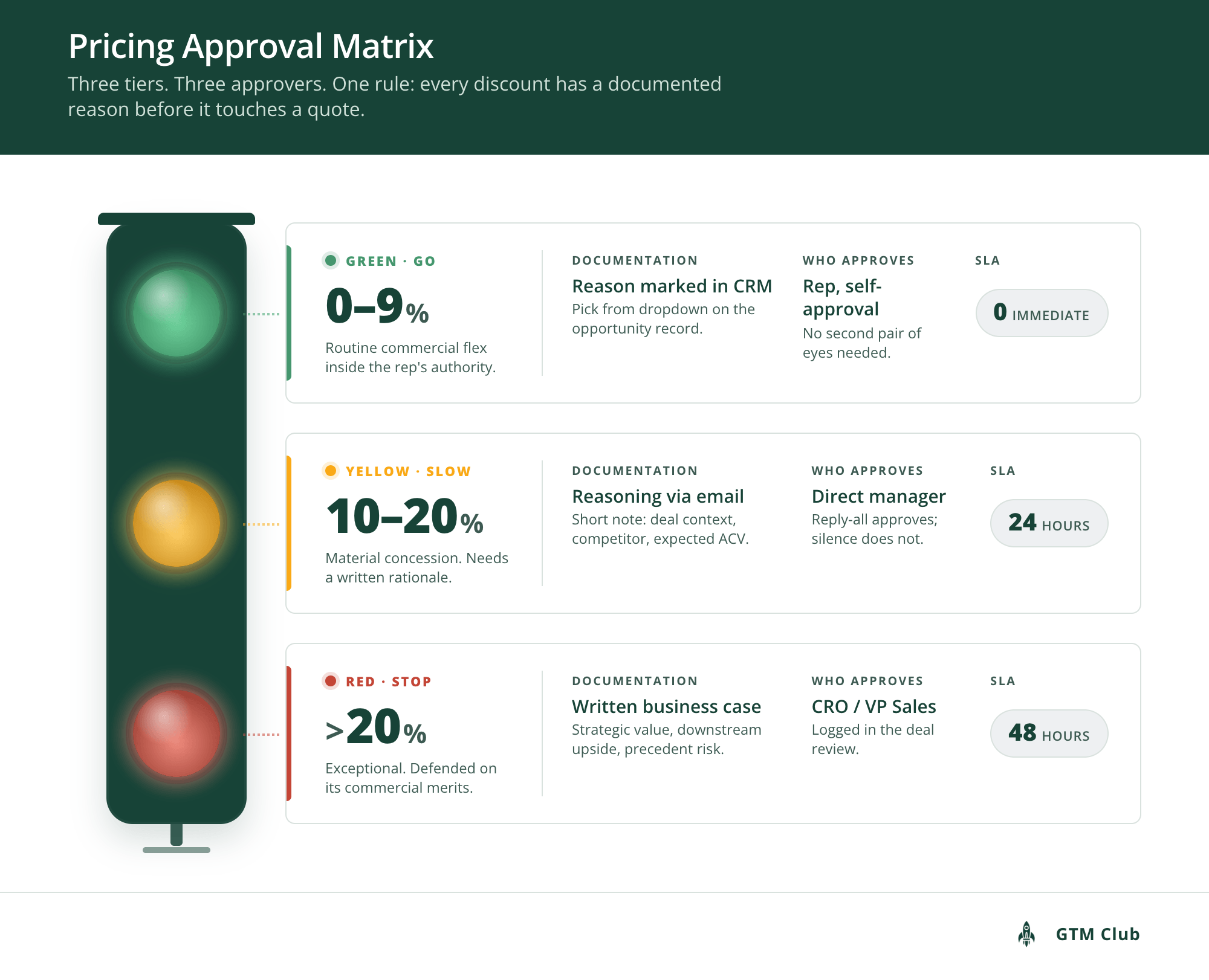
One note on thresholds. If a rep's authority ceiling is 10%, they will default to exactly 10% on every deal that requires a discount unless otherwise educated. Offering a 8.4% discount instead makes the number sound calculated rather than a reflexive maximum.
The matrix applies across revenue models, but the triggers for each tier differ. A 20% discount on a SaaS seat contract and a 20% discount on committed SMS volume carry different margin implications. Seat-based deals require segment-specific floor prices (the cost to serve an enterprise account is meaningfully higher than that for an SMB account). For transactional volume, the question is which metric gets discounted: the platform access fee or the per-unit rate. Discounting the platform fee protects per-unit margin. Discounting the per-unit rate at scale is where the real pricing leakage happens. Discount policy needs to reflect the actual revenue and margin structure, not just the headline ARR number.
Discounting Requires a Reason
Justifying discounting internally is not enough. There is an external side too.
When you give a customer a discount without explaining how it is possible, you signal that your list price was fiction. The customer walks away thinking they could have pushed harder. Or that the price they paid was not the real price.
If your rep cannot explain why the discount is possible, they should not be giving it.
The bigger the discount, the stronger the reason needs to be. A 5% loyalty discount for a multi-year renewal is easy to justify: "We are rewarding commitment with better terms." A 25% discount at close with no explanation tells the customer one thing: the margin is large enough to absorb it, and they should test that ceiling again at renewal.
Discounting without a reason does not save the deal. It costs you credibility. And the next negotiation starts from wherever they think the real floor is.
How to Monitor and Control Discounting
Pull the actual realised price per deal. That is what customers paid after all discounts and concessions, not the approved discount request. The actual realised price per deal, by rep, by segment, by quarter.
Auditing the last 12 months of closed business may surprise you. You are likely to find that discounts are not distributed evenly. A segment of reps is more active with discounts than others. That is not a rep problem. It is a coaching and visibility problem. Also, check whether any time-limited discounts are still running past their expiry date in the billing system. Discounts that were never switched off are one of the most common revenue leaks and the easiest to fix once found.
Require a reason for every discount at every level and have it logged in the CRM. That documentation requirement alone reduces casual discounting. Most casual discounts do not withstand scrutiny.
Check out our series on competitive advantage to reduce discounting and train your team to defend the value you offer.
One signal to watch consistently: the gap between your mid-quarter and end-of-quarter discount rates. If the gap is large and growing, your customers have learned the pattern. They will wait for you. And the next quarter starts with a shorter window to work in.