Create a Winning Sales Plan 2026
A good sales plan is aligned with market trends, tightly integrating sales and marketing, and clearly states roles and responsibilities. Key objectives include driving growth, retention, and managing high-value accounts. Here are our guidelines for creating one for 2026.

"Good morning, everyone. Thank you for being here today as we present our sales plan for the upcoming year."
Said the VP of Sales confidently while opening Sales Kick-Off 2025.
This could be you in a surprisingly few weeks. We at GTM Club offer our help.
Preparing for the upcoming year requires a solid sales plan that responds to emerging market trends and leverages the sales team's strengths. We suggest a plan focusing on three pillars: aligning your sales strategy with the market landscape, integrating sales and marketing efforts, and ensuring you have enough funding and the right risk profile.
You will have every reason to be confident.
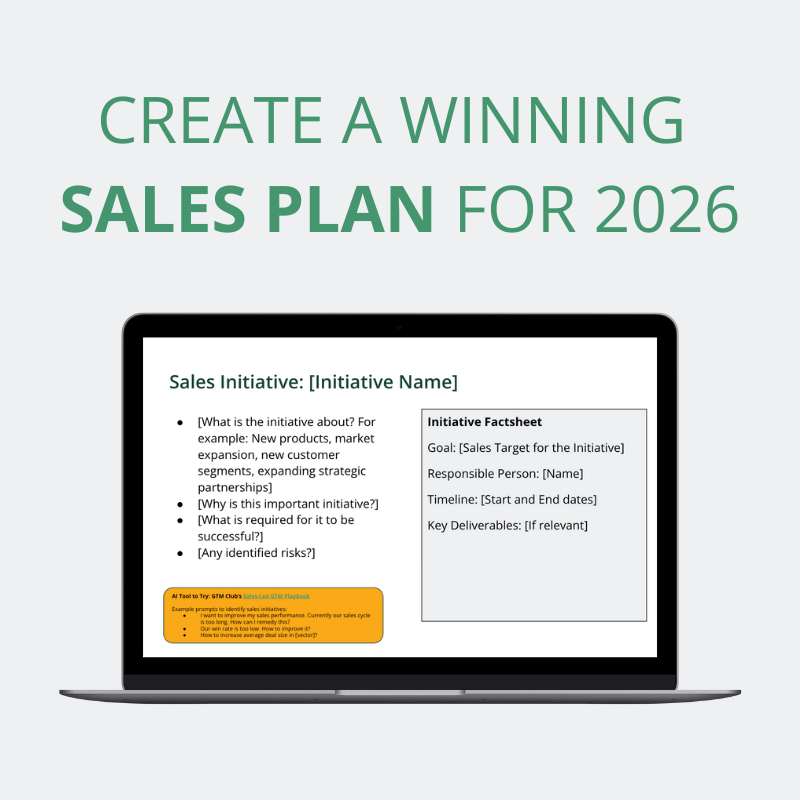
Ready to build a sales plan that sets your team up for success?
The template includes ready-to-use slides, AI prompts to accelerate your planning, and clear guidance on everything from market analysis to risk management.
Market Landscape and Sales Strategy
A vital aspect of a sales plan is understanding the factors that influence your strategy. Start by examining market insights and trends, identifying critical shifts in the industry, evolving customer needs, and the competitive landscape. This provides a clear view of opportunities and challenges to address.
A vital aspect of your sales plan is understanding the factors that influence your strategy. Start by examining market insights and trends, identifying critical shifts in the industry, evolving customer needs, and the competitive landscape. This provides a clear view of opportunities and challenges to address.
Equally important is aligning sales objectives and targets with these insights, setting realistic yet ambitious goals across different regions, products, and customer segments. The aim is to cover new customer acquisition and retention strategies while reducing churn.
The final element in this section is your sales and AI initiatives. These are the significant efforts you plan to undertake in the coming year, such as product launches, market expansions, and AI agent deployments. This is where you explain any plans to refine your value proposition due to competition. These initiatives ensure your go-to-market approach is proactive and adaptable.
Critical Areas for Consideration:
This first section answers what you aim to achieve next year and reasoning why you have selected the approach discussed in the next section.
Market Insights and Trends
- Market trends: opportunities and challenges that might impact your business
- Changes in customer needs, how you segment your customer base, and whether there are any meaningful changes in your ideal customer profile
- Competitive analysis: What is your competition doing, and if there is a threat of new players entering the fray?
Sales Objectives and Targets
- Revenue goals (by region, product, customer segment when relevant)
- How revenue growth is achieved: new customer acquisition, cross-selling, upselling, and so on
- Sales velocity improvements: Which metrics will you focus on improving (opportunities, average deal size, win rate, or sales cycle)?
- Net revenue retention and churn management: How is the current business developing? Are existing customers buying more or less from you? Why?
Sales and AI Initiatives
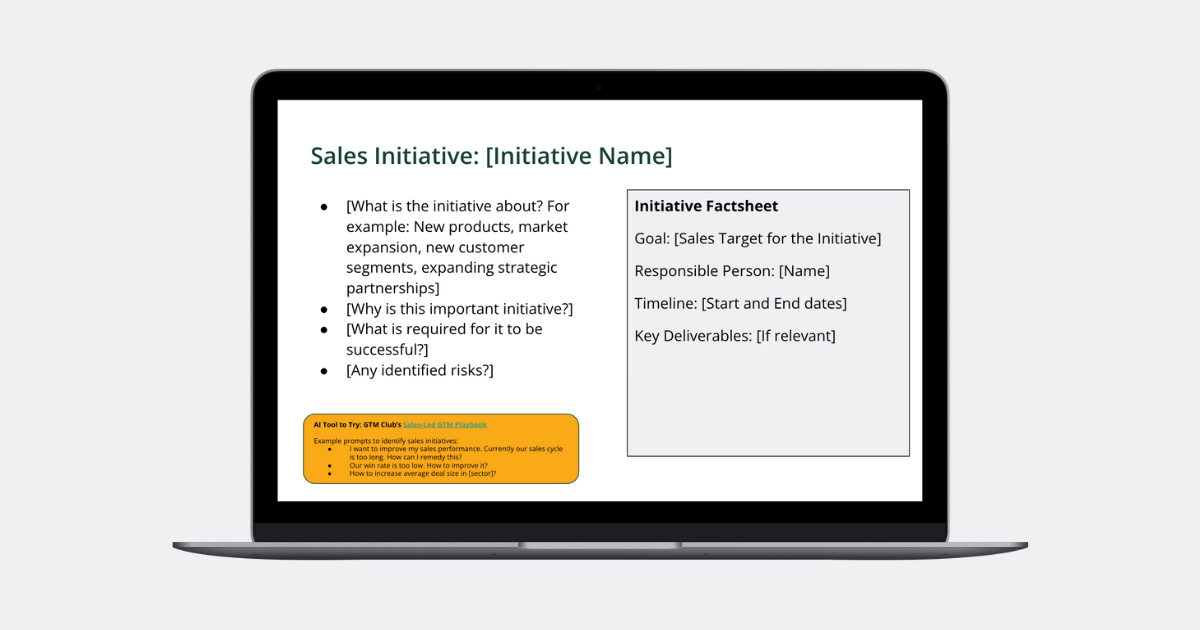
- Sales initiatives you launch: New products, market expansion, new customer segments, and expanding strategic partnerships. There are many ways to grow.
- AI initiatives: How will AI streamline operations, improve handovers, or enhance customer experience?
- Updated messaging and unique selling proposition: Are they changing? Is the message from 2025 still strong in 2026?
Working through the plan's first section gives you the big picture. You might need support from people working with customers and prospects, such as account managers and SDRs, to pull together all the data you need to consider. Also, when presenting the plan, ensure everyone understands the market landscape the same way you do. What might be crystal clear to you might not be equally clear to your boss or a fresh recruit.
Get Your Sales Plan 2026 Template Today
Inside the template, you'll find structured sections for market analysis, team alignment, and budget planning, plus bonus AI prompts to speed up competitive research and initiative planning.
Sales and Marketing Alignment
Your next focus is ensuring that sales and marketing teams are fully aligned to achieve the set sales targets, working together.
Start by addressing the sales team's structure and individual focus areas, and outline team members' roles and responsibilities. If you do this part well, everyone should understand what is expected of them. Scaling the team through hiring and training will ensure you have the right skills on board to support future growth, too.
Performance must be tracked to reach the goals. Explain the KPIs and metrics the team needs to follow in the plan. Big surprises are unlikely with sales KPIs, but it's worth recapping the most relevant ones, such as sales cycle, win rate, and sales velocity. You should explain what these KPIs are today and how they need to improve during the year. Also mention here if you are changing how the team is managed, for example, if there will be regular pipeline reviews to accelerate sales.
Lastly, the marketing plan will outline how marketing efforts support sales. This includes defining marketing goals, messaging, and the channels the marketing team will leverage for lead generation and customer engagement. Strong collaboration between sales and marketing will ensure a seamless approach to hitting shared targets. Ideally, sales and marketing should share some KPIs.
Essential Areas for Consideration:
The previous section explained what you will do and why; this one shares details on how to do it and backs it up with numbers and names.
Sales Team Structure and Focus
- Role assignments and individual sales budgets: Who sells to whom and how much. Everyone on the team must know what is expected of them.
- Key account management and high-value prospects: Which prospective accounts are must-wins that will move the needle? Which accounts need to grow next year, and how is that growth secured?
- Sales team development: When to hire new team members? What kind of training should be provided to remove skill gaps and enable AI adoption?
Performance Metrics and KPIs
- Sales pipeline overview and forecasting: When making the plan, forecast where you will start next year: Plan from where you will begin, not where you should be at year's end.
- Key metrics: Know your metrics to ensure your budgeting and forecasting are accurate. Decide which metrics to improve next year. Sales velocity, sales cycle and CAC payback period are always good choices.
- KPIs to support initiatives: Align KPIs with the big picture. If you launch a new product or AI tool, track relevant progress toward the set budget.
Marketing Plan
- Marketing goals: Is marketing working on lead generation, or is a brand and website redesign taking up all the resources?
- Key activities and marketing channels: What is marketing doing this year, and how does it impact sales? Double down on marketing and support sales by generating leads.
- Sales and marketing alignment: You should be working together. How does that show in daily operations?
Once you have calculated and assigned names to all important KPIs in this part of the plan, you should know whether you are aiming for growth targets that are too high or too low. Adjust the plan accordingly or circle back to objectives and targets if needed.
Budget, Risk Management, and Execution
The final section of your plan lays the groundwork for execution. It begins with budget and resource allocation, ensuring that investment is aligned with growth ambitions. This includes planning for new hires, sales compensation, and marketing spending while keeping operational costs in check. Issues here might lead to circling back to the beginning or previous section. Ensure you spend enough time on the budget to justify any new resources you need.
Pay attention to the available budget. Don't accept a mission impossible.
You must also spend time on risk and contingency planning to avoid or mitigate unpleasant surprises. During the year, both internal and external risks could materialise. Such events could include personnel challenges, market fluctuations, and competitors' product or feature launches. You will reduce stress by having contingency plans to mitigate these risks. A black swan event might happen, but you are still better off with some emergency plans than none.
Finally, the timeline and key milestones will map the year's goals by months or quarters and outline the critical deliverables for your strategic initiatives. There is no need to reinvent the wheel here. If you have a system that works, use it.
Main Areas for Consideration:
Ensure you spend enough time on the budget to justify any new resources you need. The budget brings all three sections together into a comprehensive plan.
Budget and Resource Allocation
- Sales and marketing budget allocation
- New hires: who, when, and how expensive are they?
- Training investments to enable AI adoption and close skill gaps
- Operational costs and sales compensation plan (everyone's favourite item in a sales kick-off!)
Risk and Contingency Planning
- Internal risks: hiring delays, personnel churn, product launch postponed, skill gaps in AI utilisation
- External risks: competition, market developments, economic shifts, and new AI tools disrupting the market
- Contingency plans to keep everyone calm.
Timeline and Key Milestones
- Monthly/quarterly sales goals will keep you on track.
- Milestones for key sales initiatives serve the same purpose.
- Progress monitoring, at both the team and individual seller levels, keeps everyone in line.
We recommend updating the sales plan as the year progresses and progress is tracked. Many things change over the course of a year, and a reaction is likely needed. A June review before summer is a natural checkpoint for this: revisit H1 performance, strip out excess, and focus on what moves you towards H2 goals. Like a battle plan, which is good until you meet the enemy, a sales plan is good until the first opportunities are closed.
Let’s get started, then! Create your winning Sales Plan 2026 with GTM Club's template. It's free for all members.
Ready to build a sales plan that sets your team up for success?
The template includes ready-to-use slides, AI prompts to accelerate your planning, and clear guidance on everything from market analysis to risk management.
What's New in the 2026 Sales Plan Template
The 2026 template introduces several important updates to help you navigate the evolving business environment.
We have added some ready-to-go prompts for you to use while creating your plan.
The most significant addition is a dedicated focus on AI, recognising that artificial intelligence is reshaping how sales teams operate. You'll now find specific sections for AI-powered workflows, from streamlining handovers between sales and customer success to identifying skill gaps in AI utilisation. We have even added some ready-to-use prompts to help you create your plan.
We've also enhanced the sales objectives section to include sales velocity as a key metric, giving you a more comprehensive view of pipeline health. These updates ensure your 2026 sales plan reflects the realities of modern selling while maintaining the proven structure that made the 2025 version successful.
 Ilkka Vertanen - GTM Club Founder
For your plan, check out what is hot in the sales-led growth in 2026.
If you're new to sales-led motions, start with our article about what sales-led GTM is.