
How to Run a Sales Pipeline Review
A pipeline review is one of the most impactful tools sales leadership has to drive action, improve sales forecasting, and, most importantly, support their sales teams. We offer a guideline on structuring the discussion for conducting an impactful pipeline review.


“Sorry, boss, I don’t think they are ready to sign. This opportunity will slip to next month.”
And so it did. More than once, along with several other opportunities.
Missed sales targets and hit-and-miss sales forecasts are starting to build pressure. The team is feeling it, and so are you. As management’s expectations intensify, you’re left grappling with the same lingering questions: What’s happening with those "sure deals"? Why is your sales team's pipeline clogged with opportunities that won’t close?
It’s frustrating to be in the dark with no clear way to regain control.
There’s a solution: regular sales pipeline reviews. By running structured pipeline reviews with each sales rep, sales managers gain more than just an update on open opportunities; they gain control and spur action. These reviews help you form a clear picture of your team's sales pipelines: their past, present, and future.
In this pipeline review guide, we cover:
- What is a pipeline review?
- Why are pipeline reviews critical?
- When to have pipeline reviews?
- How to prepare for a pipeline review?
- What does the shape of the pipeline reveal?
- What are the different ways to review the pipeline?
- What to look for in each opportunity?
- How to secure action after a pipeline review?
What is a Sales Pipeline Review?
A sales pipeline review, or more commonly just a pipeline review, is a structured meeting between a sales rep and their manager to assess the status of open opportunities. The primary focus of these reviews is to identify obstacles preventing deals from closing and to decide actions the rep or manager can take to overcome them.
Pipeline reviews are essential for evaluating the health of open opportunities, ensuring sales targets are reached, and, when needed, refocusing efforts or pushing for more activities. These reviews cover topics such as the status (including planned/agreed next steps) of the most significant opportunities, whether there is enough (new) pipeline to reach designated targets, and which deals have not moved forward since the last review (and corrective action).
The purpose of pipeline review is twofold:
- for a sales rep to get advice and guidance on identifying and overcoming blockers and risks preventing winning opportunities
- for a sales manager to support their team and gain better visibility of sales pipelines
Pipeline review is a sparring conversation to help the seller sell more. It is not a reporting meeting from one or more reps towards a manager.
Why Are Sales Pipeline Reviews Important?
As said, the most crucial outcome for pipeline reviews is identifying and overcoming blockers and risks that prevent opportunities from being won.
For sellers, pipeline reviews offer valuable support and feedback. Stalled opportunities should be reviewed to agree on revitalising action. If any dead opportunities exist, they should be lost, and energy should be directed to live ones. Planned actions for the most significant opportunities can be evaluated, and potential deal breakers can be identified and mitigated. A pipeline review should be a discussion that leaves the sales rep motivated and with a clear action plan. A great pipeline review leads to winning opportunities in no time!
Regular pipeline reviews lead to winning opportunities faster and with higher accuracy. In other words, pipeline reviews accelerate sales velocity.
For sales management, regular pipeline reviews provide a clearer understanding of pipeline health and the likelihood of meeting the team's revenue goals. Pipeline reviews are crucial for sales forecasting, as they add context compared to a numbers-only approach or to checking individual deals at random. In addition, having these conversations improves understanding of the market and the team’s skill levels and helps spot emerging challenges or risks.
When done right, pipeline reviews lead to winning opportunities faster and with higher accuracy. In other words, pipeline reviews accelerate sales velocity.
When to Have Sales Pipeline Reviews?
The ideal cadence for pipeline reviews varies. Some teams benefit from weekly reviews, while others may need them only quarterly. The cadence depends on personal preferences, team experience levels and the company's sales cycle. Finding a good cadence might require some trial and error. In any case, regular pipeline reviews are considerably more effective than ad-hoc one-offs.
Making repeatable pipeline reviews a core part of the company's sales management will move the team closer to its goals. By systematically reviewing pipelines, leadership maintain visibility into the sales team's performance, enables more accurate forecasting, and can take proactive steps to drive revenue growth.
Last but not least, your team should always have their pipeline and related activities up to date when coming into pipeline review. So, as an additional bonus, pipeline reviews help improve CRM data quality. Everybody loves good data, don't they?
If pipeline reviews are not yet part of your toolset, we strongly recommend considering and testing them. Below you will find instructions on how to start. Start accelerating your sales immediately, rather than waiting for a crisis to hit and force you. While a powerful tool, pipeline reviews best serve you over time rather than as an overnight miracle.
How to Run a Sales Pipeline Review?
Here is some guidance on structuring a pipeline review discussion. Remember, this is not a reporting meeting. This is about working together to progress and win opportunities.
Sales Pipeline Review Starts With Preparation
A pipeline review is not an ad hoc discussion. The manager and the seller must come prepared.
How to prepare:
- Manager and sales rep: Both need to recap the agreed action points from the previous review.
- Manager: Review the notes from the previous meeting, the rep's KPIs, and targets. Form a general understanding of where to focus in the review.
- Sales rep: The pipeline needs to be up to date, including past and planned sales activities. Ideally, the rep should recognise a few opportunities to ask for support.
Observe the Pipeline from a Bird's-Eye View
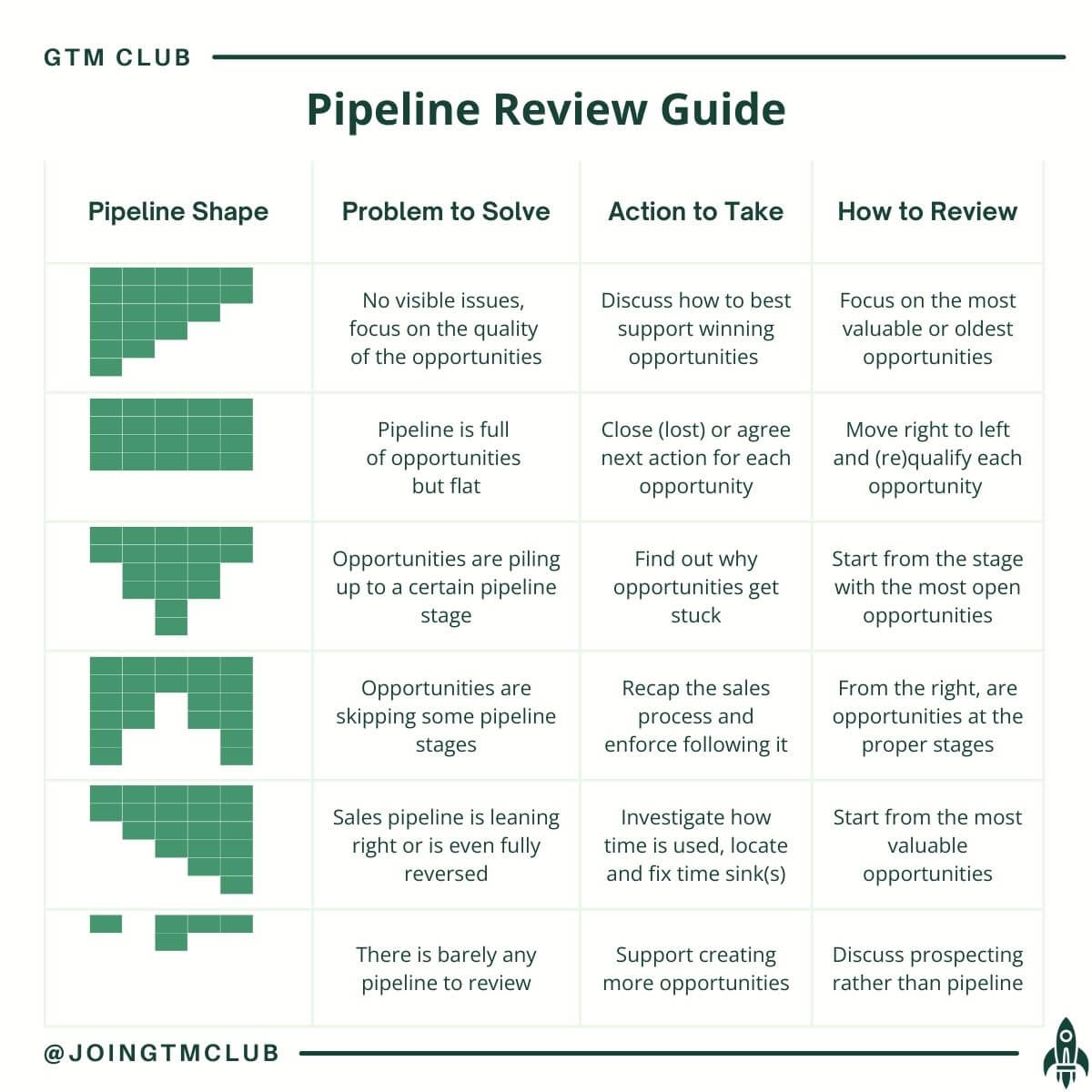
Have a look at the shape of the pipeline. Does it look like a proper pipeline, or should you take some action on a high level? Zoom out. What do you see?
The pipeline may include old or unqualified opportunities, even if they appear accurate.
A bird's-eye view is essential when starting pipeline review. As you conduct reviews regularly, the trend should be to move your team towards the correct shape and size of the pipeline. Do note that the pipeline may include old or unqualified opportunities, even if they appear accurate. So, always dig deeper.
Different Ways to Review Sales Pipeline
When running these reviews regularly, it is good practice to vary the order to ensure that all deals are reviewed over time rather than always discussing the same ones. It's doubtful that you can review all opportunities to any depth at one go.
Presuming the stage with the most deals is not the left-most stage, this is where you will find an opportunity “graveyard.”
There is always some flexibility in conducting the pipeline review, and adapting to the individual sales rep is advised.
- Start from the right side of the pipeline, with the opportunities closest to being won. This will improve sales numbers in the short term.
- Focus on the biggest/most strategic deals, wherever they may be in the pipeline. These are the important ones that really move the needle, so it's good to stay on top of them.
- Move from left to right and focus on the latest addition to the pipeline. This approach helps evaluate opportunities from a qualification and discovery perspective, improving opportunity quality early on and positively impacting sales numbers later.
- Evaluate from the oldest opportunity to the newest additions. Do this to clean the pipeline of old stagnant opportunities. You should focus on challenging the rep if some of their opportunities should be open anymore. This is a good way to reveal how the pipeline actually looks like.
- Inspect the stage with the most opportunities first. Presuming the stage with the most deals is not the left-most stage, this is where you will find an opportunity “graveyard.” Reviewing these opportunities will most likely lead to a coaching opportunity.
Dive Deep into Each Opportunity in the Pipeline
After establishing the big picture, it’s time to zoom in. Start going through each opportunity together with your sales rep. Let them present the opportunity and then ask questions.
Just a friendly reminder: the idea is not to look for mistakes but to find ways to help the sales rep win their opportunities and, when needed, refocus the efforts by closing some opportunities as lost. After all, there should be no open opportunities in the pipeline that can’t be won within a reasonable time.
The goal is not to look for mistakes but to find ways to help the sales rep win their opportunities.
With each opportunity, the sales rep should be able to present at least the following:
- Why is this a good opportunity to work on? What are the challenges the prospect is facing at the moment?
- Who belongs to the decision-making unit in this opportunity? Do we know all the members?
- What happens next, and by whom? What needs to be done to close the opportunity as won?
As opportunities progress through the pipeline, the amount of details increases. It is advised to use frameworks, such as CHAMP or MEDDIC, to evaluate the deal with the sales rep. Use the same framework here as your company uses for opportunity qualification and discovery normally.
Before you move on to the next opportunity, there should be clear next steps and actions agreed for each one. Either already by a rep, or you plan them together. A good rule to live by is that if it’s not in the CRM, it didn't happen. Also, if it's not added to the CRM during the review, it will not happen.
If it’s not in CRM, it did not happen. If it's not added to CRM, it will not happen.
Do not let the sales rep dismiss some opportunities as “business as usual” or “nothing new there.” Those are the opportunities you definitely should spend some time on.
Here are some examples of what to keep your eyes open for and ideas for corrective action:
❌ Sales demo was a month ago. No clear next steps were agreed upon, nor a problem to solve was identified. Prospect "is discussing it internally" and has not responded to multiple contact attempts.
✅ Do you have or can you gain access to other decision makers? If yes, reach out to them. If not, consider the deal lost and focus on other opportunities.
❌ Proposal sent; waiting to hear back after the prospect has discussed it internally.
✅ Make sure you understand their decision-making process. Set up a call to review the proposal together with all the decision-makers.
❌ The proposal was presented last week. Next week, they are presenting internally to the economic buyer whom the seller has not met. Two competing offers are on the table. It's a nailbiter!
✅ Consider sending a video greeting that recaps the agreed-upon pain point and proposed solution to accompany the proposal. This one would also benefit from a management handshake.
Finish Pipeline Review With a Summary and Action
At the end of the pipeline review, do the following:
- Revisit the bird' s-eye view of the sales funnel. Especially if you have discovered many “zombie” opportunities that were closed as lost, the funnel's shape might have drastically changed. Agree on a high level on what needs to happen between now and the next review (e.g., generating a new pipeline).
- Discuss if a recurring theme emerged in each reviewed opportunity (such as the lack of next steps). If so, this topic is worth keeping in mind and improving on as you go.
- On the opportunity level, ensure that agreed action points are documented in the CRM. Note and agree to any other required action, such as the manager coordinating additional support from marketing. Both need to commit to carrying out planned actions.
We recommend using an AI notetaker or Copilot to transcribe your pipeline reviews. If you do so, test our prompt for actionable notes.
As a manager, look for similarities between pipeline review findings and your reps. For example, you might notice that most of your team struggles with discovery or product knowledge. Such a finding is an action point for you to address and arrange additional training and support for them.
When running sales pipeline reviews according to these guidelines, they empower the sellers, drive more activities, and improve sales forecast accuracy.
Note: This article was originally published on September 29, 2024, and has since been updated and edited for clarity.